ceramic
Networks | Ceramic Developers
Networks are collections of Ceramic nodes that share specific configurations and communicate over dedicated libp2p topics. Networks are discrete from one another. Streams that exist on one network are not discoverable on or portable to another. Ceramic has three public networks that you can use when building applications: Mainnet, Clay Testnet, and Dev Unstable.
 https://developers.ceramic.network/learn/networks/
DID DataStore | Ceramic Developers
The DID DataStore is an implementation of the Identity Index (IDX) CIP, allowing to associate records to a DID. Dive into the design and architecture of the IDX protocol, which is implemented by the DID DataStore. The index is a stream controlled by the user's DID which stores entries consisting of definition (represented by a streamID) to record (represented by a streamID) mappings.
https://developers.ceramic.network/tools/glaze/did-datastore/Overview | Ceramic Developers
Specs, docs, guides, and APIs for the Ceramic Network.
https://developers.ceramic.network/tools/idx/overview/Build web apps with Ceramic and 3ID Connect
Being able to use Ceramic directly from the convenience of your web browser is one of the core functionalities required to fulfill the vision of a permissionless dataweb. 3ID Connect enables this by providing a sandboxed IdentityWallet instance which users can authenticate to using any of their existing Ethereum wallets, and soon other Blockchain wallets as well.
 https://blog.ceramic.network/tutorial-build-web-apps-with-ceramic-and-3id-connect/
https://github.com/ceramicstudio/3id-connect
Ipfs - Ceramic - Medium
Read writing about Ipfs in Ceramic. Ceramic is an open protocol for creating smart documents and publishing, managing, linking and querying verifiable information and identities. Find stories from our journey building an open dataweb at blog.ceramic.network.
 https://medium.com/ceramic/tagged/ipfs
Learn how to manage user data in a Web3 app with IDX
Learn how to manage user data for your Web3 application with IDX. This talk is a workshop from ETHDenver 2021.
https://blog.ceramic.network/learn-how-to-manage-user-data-in-a-web3-app-with-idx/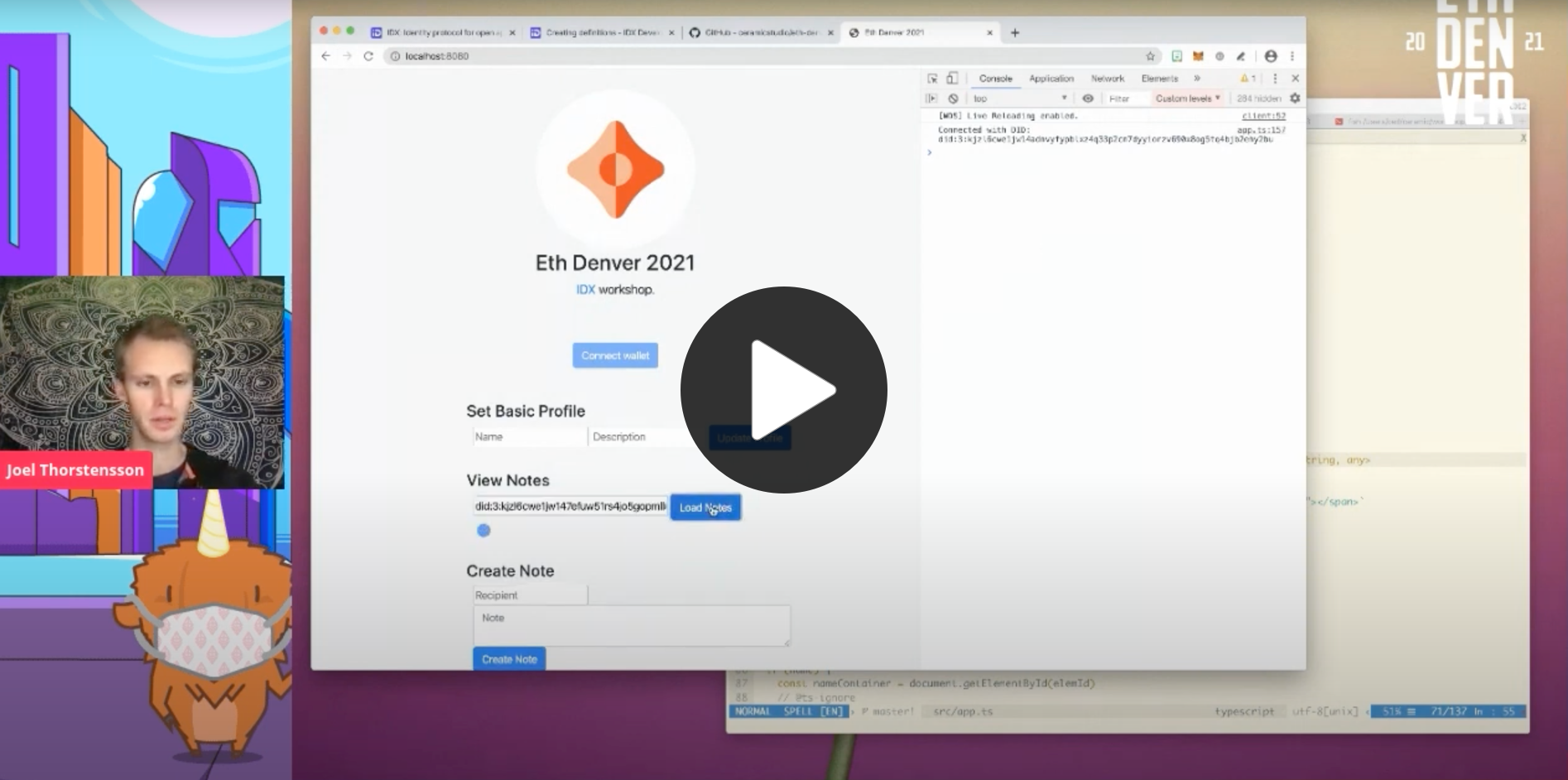
How to store signed and encrypted data on IPFS
Storing authenticated and encrypted data on IPFS is a core building block for many Web3 applications, but to date there has not been a standardized way to encode this type of data. Without a standard, many developers have been forced to create custom formats for their signed and encrypted data.
https://blog.ceramic.network/how-to-store-signed-and-encrypted-data-on-ipfs/
Building with decentralized identity on IDX and Ceramic
As part of the Gitcoin Grants Round 8 Hackathon, the IDX team gave a workshop on building applications with decentralized identity using IDX and Ceramic. Watch the full workshop below.
https://blog.ceramic.network/building-with-decentralized-identity-on-idx-and-ceramic/
Quick Start | IDX Developers
Get started exploring what's possible with IDX using the IDX CLI. For runtime usage in your project, you will need to install the IDX SDK. IDX is in alpha. Libraries may be unstable and APIs are subject to change. Data created on IDX during alpha will not be portable to production.
 https://developers.idx.xyz/build/quick-start/
https://blog.ceramic.network/how-to-build-a-simple-notes-app-with-idx/
IDX is a protocol for building applications with user-centric, interoperable data. In a previous post, we described what IDX is and the benefits of building applications in this way. This tutorial will walk through the creation of a simple note-taking web app using decentralized technologies for authentication and data storage, allowing users to have complete ownership over their contents.
https://blog.ceramic.network/how-to-build-a-simple-notes-app-with-idx/
Dependency APIs | IDX Developers
These interfaces are used by IDX, but provided by other libraries.
https://developers.idx.xyz/reference/dependency-apis/#didPackages | IDX Developers
Specs, docs, guides, and APIs for the IDX protocol
https://developers.idx.xyz/learn/packages/#idx-sdkhttps://github.com/ceramicstudio/js-3id-did-provider
Tutorial: Build web apps with Ceramic and 3ID Connect
Being able to use Ceramic directly from the convenience of your web browser is one of the core functionalities required to fulfill the vision of a permissionless dataweb. 3ID Connect enables this by providing a sandboxed IdentityWallet instance which users can authenticate to using any of their existing Ethereum wallets, and soon other Blockchain wallets as well.
https://medium.com/ceramic/tutorial-build-web-apps-with-ceramic-and-3id-connect-bd1353b8876a

Ceramic HTTP API | Ceramic Developers
The Ceramic HTTP API is the standard lowest-level communication protocol between clients and nodes on the Ceramic network. It allows client applications to manually make REST HTTP requests to a remote Ceramic node to send transactons, retrieve data, and "pin" data to make it available.
https://developers.ceramic.network/build/http/api/Image utilities | Ceramic Developers
Image utilities for Self.ID profiles. The image-utils module provides various utility functions for images, such as selecting the most suitable format among sources, resizing and uploading, and is mostly meant to be used in a Web browser context.
https://developers.ceramic.network/reference/self-id/modules/image_utils/Uploading Files to IPFS from a Web Application
One of the most common interactions with IPFS is uploading files like images and videos from a client-side application, so I found it surprising that there were not a lot of straightforward tutorials showing how this is done. In this tutorial you will learn just that in as few lines of code (and as simply) as possible using ipfs-http-client .
 https://dev.to/dabit3/uploading-files-to-ipfs-from-a-web-application-50a
How to build a simple notes app with IDX
IDX is a protocol for building applications with user-centric, interoperable data. In a previous post, we described what IDX is and the benefits of building applications in this way. This tutorial will walk through the creation of a simple note-taking web app using decentralized technologies for authentication and data storage, allowing users to have complete ownership over their contents.
https://blog.ceramic.network/how-to-build-a-simple-notes-app-with-idx/How to store encrypted secrets using IDX
This tutorial will demonstrate how to allow users of your application or platform to encrypt secrets with a DID and store them in their IDX. Apps and libraries can use this pattern to easily store and recover seeds, secret keys, personal information, application data, and credentials that they may need for their own systems, simply based on the ability to authenticate a DID.
https://blog.ceramic.network/how-to-store-encrypted-secrets-using-idx/
How to store signed and encrypted data on IPFS
Storing authenticated and encrypted data on IPFS is a core building block for many Web3 applications, but to date there has not been a standardized way to encode this type of data. Without a standard, many developers have been forced to create custom formats for their signed and encrypted data.
https://blog.ceramic.network/how-to-store-signed-and-encrypted-data-on-ipfs/Build web apps with Ceramic and 3ID Connect
Being able to use Ceramic directly from the convenience of your web browser is one of the core functionalities required to fulfill the vision of a permissionless dataweb. 3ID Connect enables this by providing a sandboxed IdentityWallet instance which users can authenticate to using any of their existing Ethereum wallets, and soon other Blockchain wallets as well.
https://blog.ceramic.network/tutorial-build-web-apps-with-ceramic-and-3id-connect/
How to Build REST API with Node.js from Scratch | Edureka
Since the invention of WWW, various web technologies like RPC or SOAP were used to create and implement web services. But these technologies used heavy definitions for handling any communication task. Thus, REST was developed which helped in reducing the complexities and provided an architectural style in order to design the network-based application.
 https://www.edureka.co/blog/rest-api-with-node-js/
How To Create a Web Server in Node.js with the HTTP Module | DigitalOcean
When you view a webpage in your browser, you are making a request to another computer on the internet, which then provides you the webpage as a response. That computer you are talking to via the internet is a web server.
 https://www.digitalocean.com/community/tutorials/how-to-create-a-web-server-in-node-js-with-the-http-module
Sign in with Ethereum & Decentralized Identity with Ceramic, IDX, React, and 3ID Connect
Instantly share code, notes, and snippets. Sign in with Ethereum & Decentralized Identity with Ceramic, IDX, React, and 3ID Connect You can't perform that action at this time. You signed in with another tab or window. You signed out in another tab or window. Reload to refresh your session.
IDX SDK | IDX Developers
npm install @ceramicstudio/idx Arguments: Returns whether a DID is currently authenticated. Returns the DID of the currently authenticated user. Accessing this property will throw an error if the instance is not authenticated. Returns whether a record exists in the index for a given DID.
https://developers.idx.xyz/reference/idx/
Tile Document | Ceramic Developers
The stream-tile module exports a TileDocument class used to store and load JSON documents using the CIP-8 "Tile Document" streamcode, as well a provide accessors to the contents and metadata of a given version of the stream. npm install @ceramicnetwork/stream-tile In order to create a document, an authenticated DID needs to be attached to the Ceramic client instance to enable transactions (signing commits).
https://developers.ceramic.network/reference/stream-programs/tile-document/
Tile loader module | Ceramic Developers
Batching and caching for Ceramic streams. The tile-loader module exports a TileLoader class providing batching and caching for Tile load and creation in order to improve client-side performance. npm install @glazed/tile-loader Batching consists in the process of combining multiple concurrent queries to a Ceramic node into a single one.
https://developers.ceramic.network/reference/glaze/modules/tile_loader/How to build a simple notes app with IDX
IDX is a protocol for building applications with user-centric, interoperable data. In a previous post, we described what IDX is and the benefits of building applications in this way. This tutorial will walk through the creation of a simple note-taking web app using decentralized technologies for authentication and data storage, allowing users to have complete ownership over their contents.
https://blog.ceramic.network/how-to-build-a-simple-notes-app-with-idx/Writing records | IDX Developers
Use the method to create or modify a record at runtime. Writing to records requires having an authenticated user. All writes will be performed by that user and applied to their records. Pass an alias from default aliases and the data that you wish to write to the record.
https://developers.idx.xyz/build/writing/
Tile loader module | Ceramic Developers
Batching and caching for Ceramic streams. The tile-loader module exports a TileLoader class providing batching and caching for Tile load and creation in order to improve client-side performance. npm install @glazed/tile-loader Batching consists in the process of combining multiple concurrent queries to a Ceramic node into a single one.
https://developers.ceramic.network/reference/glaze/modules/tile_loader/
Connect to Ethereum Node
Fast and Reliable Full Nodes and Archive Full Nodes for Ethereum, Ropsten, Goerli, Rinkeby, and Kovan!
 https://docs.moralis.io/speedy-nodes/connecting-to-rpc-nodes/connect-to-eth-node
Tile Document (CIP-8) | Ceramic Developers
Tile Document (CIP-8) is streamcode that stores a mutable JSON document with schema validation, providing similar functionality as a NoSQL document. Mutable JSON Storage - TileDocuments are used for storing JSON data. Every TileDocument stream is structured as a single log of commits, where each commit only contains the diff from the previous version.
https://developers.ceramic.network/docs/advanced/standards/stream-programs/tile-document/
Installing the JS HTTP Client | Ceramic Developers
Specs, docs, guides, and APIs for the Ceramic Network.
https://developers.ceramic.network/build/javascript/http/https://github.com/ceramicnetwork/js-ceramic
Installing the JS HTTP Client | Ceramic Developers
Specs, docs, guides, and APIs for the Ceramic Network.
https://developers.ceramic.network/build/javascript/http/How to build a simple notes app with IDX
IDX is a protocol for building applications with user-centric, interoperable data. In a previous post, we described what IDX is and the benefits of building applications in this way. This tutorial will walk through the creation of a simple note-taking web app using decentralized technologies for authentication and data storage, allowing users to have complete ownership over their contents.
https://blog.ceramic.network/how-to-build-a-simple-notes-app-with-idx/
Launching in the cloud | Ceramic Developers
This guide provide complete instructions and various tools for launching a highly-available, well-connected Ceramic node in the cloud. At this time, any application that wishes to deploy to mainnet needs to run their own node.
https://developers.ceramic.network/run/nodes/nodes/How to build a simple notes app with IDX
IDX is a protocol for building applications with user-centric, interoperable data. In a previous post, we described what IDX is and the benefits of building applications in this way. This tutorial will walk through the creation of a simple note-taking web app using decentralized technologies for authentication and data storage, allowing users to have complete ownership over their contents.
https://blog.ceramic.network/how-to-build-a-simple-notes-app-with-idx/IDX: A Devkit for Open Identity
IDX is a brand new SDK for building with decentralized identity and user-centric data from the 3Box Labs team. IDX is in alpha but if you'd like to start experimenting, join our discord and jump into the docs . The Web3 vision for an internet that is open and interoperable, where users control their information requires a decentralized, cross-platform identity system.
https://medium.com/3box/idx-a-devkit-for-open-identity-48edc88e8e85

https://bafybeifgarqadnrak4y7zx6fsk3z5ad4fsjxqgpg37sppp4mpxmmyftccq.ipfs.dweb.link/